Guest Article: Playing with Nuclear War

by

Bill Lind

As of this writing (September 12), Ukraine’s counter offensives appear to be succeeding. The widely telegraphed offensive in the south is making some progress. But it looks as if its primary role was deception, where it has already succeeded because Russia responded by drawing down its forces in eastern Ukraine, opening the door for the main Ukrainian counteroffensive. That is moving forward at Blitzkrieg pace, to the point where Russian units are disintegrating. All this is, of course, wonderful news for Ukraine and for anyone who wants to see David beat Goliath.

But interests must be matters of cold calculation, not warm emotions. Foreign policy is more than consulting Sant’s list of who is naughty or nice. Yes, the Russians have been beasts and their invasion of Ukraine has been criminal. But Ukraine’s victories are not good news for America’s most vital interest.

What is that most vital interest? Avoiding nuclear war.

Throughout the Cold War, everyone in Washington understood this. Party did not matter, liberal or conservative was of no consequence. The whole foreign and defense policy establishment knew we and the Soviets were walking on eggs. The slightest mis-step could mean nuclear catastrophe. We came close on occasion; the closest was probably during the Cuban missile crisis, when the skipper of a Soviet submarine was about to fire a nuclear torpedo at an American destroyer. His politruk stopped him. As the representative of the Party, he knew Moscow did not want nuclear war any more than Washington did.

But it seems all the adults in the room died and a bunch of drunk teenagers now have their fingers on the button. Russia has hinted from the outset of its invasion of Ukraine that the nuclear option is available. If the Russian army is beginning to disintegrate, I suspect that option is or soon will be on the table.

What would it mean? My guess is one or more nuclear strikes in western Ukraine, aimed at the supply lines bringing in American and European weapons. Initially, I don’t think they would attack NATO territory. But the winds blow east to west in Europe, and the fallout could be considered a weapon on its own.

This is, of course, madness in Moscow. President Putin regrets the break-up of the Soviet Union; some old Party hands should remind him that no Soviet leader would ever have started a nuclear war. Had one moved to do so, he would immediately have been recognized as a Trotskyite and toppled.

Unfortunately, the situation in Washington is as bad or worse. Some circles there are planning to respond with American nuclear strikes if Russia uses nukes in Ukraine. But what could our targets be? If we target Russian-held regions of Ukraine such as Donbas, we create the bizarre situation where Moscow and Washington are both nuking Ukraine. The latter will find out what it was like to be Germany during the Thirty Years War, the place where everyone from Swedes to Spaniards fought it out. Some German towns still have not recovered.

It does not stop there. These same circles (hint: there’s a “neo” in their name) know this, plan to hit targets on Russian territory and are calmly discussing the fact that we might lose some east coast cities. The U.S. military has reportedly been directed to develop contingency plans for such a situation.

Playing with nuclear war goes beyond folly. It is insanity, plain and simple, straight out of Dr. Strangelove.

If there are any adults left in Moscow or Washington, they need to kick the teenagers out of the room, consider their interests rationally and sit down and talk. Let us imagine the man we need, old Bismark, returns as the Ghost of Crises past (I think Turkish President Erdogan might serve as his avatar). Here’s a draft agreement:

Russia has a legitimate interest in Ukraine, namely that it does not constitute a threat to Russia. That means Ukraine will not be allowed to join NATO, although it may join the EU. If Ukraine succeeds in retaking Donbas, it returns to Ukraine, but as a special autonomous region with some degree of self-government and a general amnesty. If Russia can hold it, it stays Russian.

Russia keeps Crimea, because it has historically been Russian. Like the Donbas, the Russian corridor connecting Russia proper to Crimea stays with whoever holds it when the fighting stops.

In return for Russia getting Crimea, Ukraine gets East Prussia (now called the “Kaliningrad Oblast”) and a new, broad-gauge, heavy-haul railway connecting Konigsberg to Ukraine, giving Ukraine two seas through which it can export its agricultural products.

Finally, Russia joins an international consortium to rebuild Ukraine, with Russia allowed to concentrate its efforts in towns and cities where the population is heavily Russian.

In all this, there is one point Washington must keep in mind above all others: the United States has no vital interests at stake in Ukraine. That is why it is insanity for us to be contemplating nuclear war. For what? How do we benefit?

The thought that, having avoided nuclear war with the Soviet Union for all those years, we are now planning for a nuclear war with a non-Communist Russia is beyond rational comprehension.
 

Will Russia Win?

Like almost all other Westerners, at the time the Russian-Ukrainian War broke out in February 2022 I was convinced that the Russians would fail to reach their objectives and lose the war. Putting the details aside, this prediction was based on the following main three pillars.

First, the numerous failures, after 1945, of modern, state-run armed forces to cope with uprisings, insurgencies, guerrilla warfare, terrorism, asymmetrical warfare, and any number of similar forms of armed conflict. Think of Malaysia—yes, Malaysia, so often falsely claimed by the British as a victory. Think of Algeria, think of Vietnam, think of Iraq, think of dozens of similar conflicts throughout Asia and Africa. Almost without exception, it was the occupiers who lost and the occupied who won.

Second, the size of Ukraine’s territory and population made me and others think that Russia had tried to bite off more than it could swallow. The outcome would be a prolonged, very bloody and very destructive, conflict that would be decided not so much on the battlefield but by demoralization both among Russia’s troops and among its civilian population. As, indeed, happened in 1981-1988 when the Soviet Union invaded Afghanistan, only to get involved in a lengthy counter-insurgency campaign that ended not just in military defeat on the ground but in the disintegration of the Soviet Union. This line of reasoning was supported by the extreme difficulty the Russians faced before they finally succeeded in bringing Chechnya, a much smaller country, to heel.

Third, plain wishful thinking—something I shared with most Western observers. Including heads of state, ministers, armed forces, intelligence services, and the media.

Since then four very eventful months have passed. As they went on, the following factors have forced me to take another look at the situation.

First, the Ukrainians are not fighting a guerrilla war. Instead, as the list of weapons they have asked the West to provide them with shows, they have been trying to wage a conventional one: tank against tank, artillery barrel against artillery barrel, and aircraft against aircraft. All, apparently, in the hope of not only halting the Russian forces but of expelling them. Given that the Russians can fire ten rounds for every Ukrainian one, such a strategy can only be a sure recipe for defeat.

Second, a change in Russian tactics. Greatly underestimating their enemies, the Russians started the war by attempting a coup de main against the center of Ukrainian power at Kiev. When this failed it took them some time to decide what to do next; they may even have replaced a few of their top ranking generals. But then they regrouped and switched to the systematic reduction of Ukrainians cities and towns. Much as, in 1939-40, Stalin and his generals did to Finland. As in both that war and World War II as a whole they resorted to what has traditionally been their most powerful weapons, i.e massed artillery. It now appears that the change enabled them to reduce their losses to levels that they can sustain for a long time. Perhaps longer than the Ukrainians who, by Zelensky’s own admission, are losing as many as 100-200 of their best fighters killed in action each day.

Third, Western military technology, especially anti-aircraft weapons, anti-tank weapons, and drones may be excellent. However, limited numbers, the result of years and years of parsimony and the belief that war in Europe had become impossible, plus the need to retrain the relevant Ukrainian personnel, means that it has been slow to arrive in the places where it is most needed. Not to mention the fact that, whereas the Russians are fighting close to home, NATOs lines of communication stretch over hundreds of miles all the way from Ukraine’s borders with Poland, Slovakia and Romania in the west to the Donbas in the east. Almost all the terrain in between is flat, devoid of shelter, and thinly populated. Meaning that it is ideal for the employment of airpower, precisely the field in which Russian superiority over Ukraine is most pronounced.

Fourth, strict censorship is making the impact of Western economic sanctions on Russia’s population hard to asses. If there is any grumbling, it is being energetically suppressed. Meanwhile, a look at the macroeconomics seems to show that Russia is coping much better than many Westerners expected. Gold reserves have been inching up, enabling Putin to link his currency to gold—the first country to do so since Switzerland went in the opposite direction back in 1999. The Ruble, which early in the war came close to collapse, is back to a seven-year high against the dollar, trend upward. Given the fall in imports as well as the tremendous rise in energy prices, more money is flowing into Russia’s coffers than ever before. Most of that money comes from selling energy, foodstuffs and raw materials to countries such as China and India. China in turn is now the world’s number one industrial power; once its current troubles with COVID-19 are over, it should be well able to provide Russia with almost any kind of industrial product it needs, and do so for a long time to come.

Fifth, the economic impact of the war on the West has been much greater than anyone thought. Saving Ukraine form Russian’s clutches is not like doing the same with Afghanistan. On both sides of the Atlantic inflation is higher than it has been at any time since 1980. Especially in regard to energy, which Russia is refusing to provide Europe with, it is giving rise not just to confusion but to some real hardship. Should it continue, as it almost certainly will, it will give rise to growing popular discontent with the war and demands that their countries’ involvement in it be reduced or brought to an end. Even if that end means abandoning Ukraine and allowing Putin to have his way with it.

Last not least, beginning with the Enlightenment the West has long preened itself on being a fortress where liberty, law and justice prevail. Now the repeated, highly publicized, requisitioning of the property of so-called oligarchs is beginning to make some people wonder. First, no one knows what an “oligarch” is. Second, the fact that some “oligarchs” have been in more or less close touch with Putin over the years does not automatically turn them into criminals. Third, supposing they are criminals, it is not at all clear why they were left alone for so long and only began to be targeted after the war broke out. Could it be that, in combating the oligarchs, the West is undermining the justice of its cause?

To be sure, we are not there yet. But as growing number of statements that the war is going to be a long one show, it is now primarily a question of who can draw the deepest breath and hold out the longest. And when it comes to that, Russia’s prospects of coming out on top and obtaining a favorable settlement are not at all bad.

The Other Side of the Coin

As many readers of this blog know, NATO and the US have been pressing Switzerland to abandon its long-standing policy of neutrality and join them in supporting the good, blameless, democratic Ukrainians against the big bad Russians. Conversely many Swiss media, reluctant to see their country embark on that road, has been bristling with stories that, being less than complimentary to Ukraine, are not always easy to find in English-language sources. Based on an article in Weltwoche, a moderately right-wing Swiss weekly, the following are summaries of a few such stories.

  1. In the West, the terms “Russia” and “oligarchs” are regarded as almost synonymous. In fact, though, Ukraine’s Zelensky is quite as dependent on filthy rich, not always nice and kind, backers as his rival Putin is. In return, no sooner had he come to power in April 2019 than he started pushing through a comprehensive program aimed at privatizing state-owned land. 40 million hectares of it, no less. Continuing policies originally put in place when Ukraine gained its independence in 1991, this reform was accompanied by others: including cuts in social services, changes in labor law aimed at favoring employers at workers’ expense, and more. The result? In 1991 its per capita income was slightly than to that of Russia. Over the next thirty years it dropped to just one third of that figure. No wonder that, by the time the war broke out in February 2022, public support for Zelensky had dropped by two thirds.
  2. Again in the West, the terms “Russia“ and “corruption” are regarded as almost synonymous. In fact, however, there is little to choose between Russian corruption and that which prevails in Kiev. According to one source quoted by Weltwoche, back in 2015 Ukraine was the most corrupt country in Europe. Six years later Transparency International, a Berlin-based organization, ranked it 122nd in the world, just barely ahead of Russia. Corruption, so Weltwoche, is endemic: in ministries, in the bureaucracy, in the public services, in parliament, in the police, and—surprise surprise-even in the High Court specifically charged with combating it. Zelensky himself is said to have received millions from questionable backers in- and out of the country; some of the money was registered on his wife’s name, and some of it was deposited offshore. Among those implicated was Hunter, the son of U.S President Joe Biden. Presumably it was these contributions which, among other things, enabled Zelensky to spend some of his vacations not in the Carpathians or on the shores of the Black Sea—both of them prime vacation areas, by the way-but in the kind of Western resorts that charge tens of thousands of dollars per night.
  3. When Putin proclaimed that one of his objectives was to “de-Nazify” Ukraine, Western media were quick to point out that Zelensky himself is Jewish or, at any rate, has Jewish roots. That is true, but two points seem worth making. First, those Jewish roots are rather remote and, inside Ukraine, are rarely mentioned. Second, as may be clearly seen from the tattoos they carry on their faces, trunks, shoulders and arms, many of Zelensky’s most determined supporters identify with the Nazis, Hitler and the SS specifically included. At least one, chief of the so-called National Corps (and one time member of parliament) Andryi Bilestsky, has gone so far as to declare a crusade against the Jew-directed efforts of “sub-human” peoples to do away with the white races. Indeed Ukrainian right-wing organizations are not unlike America’s militias. Except that they are much better organized, armed, and trained; and except that, rather than being marginal to the country’s political life, they form the indispensable mainstay of Zelensky’s regime.
  4. Even before the beginning of the war, Zelensky’s own regime was showing signs of becoming increasingly authoritarian. Opposition politicians, accused of cooperating with the enemy, have been intimidated, kidnapped and, occasion, shot at. Opposition media have been closed, opposition parties prohibited.
  5. Arrests, kangaroo courts, and even torture have become widespread. It is true that Ukrainian troops did not abuse the civilian population quite as much as Russian ones did (not operating on Russian territory, they simply did not have the opportunity). The abuses that did take place, though, were bad enough; as, for example, when Ukrainian militiamen, acting in broad daylight, seized known left-wingers, stripped them, and beat them up. While the West has focused on the Russian maltreatment of Ukrainian (and a few foreign) prisoners of war, it has ignored cases when Ukrainian troops opened fire on Russian prisoners.

The Weltwoche article that served me as the basis for this post takes up four pages of dense German. I got them down to just eight hundred words, the normal length of an Op-Ed. By no means do I wish to imply that Russia is right and Ukraine, wrong. Only, perhaps, that both sides are not as different as they are usually made out to be—and that, as time goes on, they are steadily becoming less so.

Truth to Say, Qui lo Sa?

Now that the initial momentum has been spent and replaced by attrition (on both sides), it is possible to speculate about the outcome of the war everyone has been talking about for the last few months.
So here we go.

Outcome No 1. The Ukrainians, supported by the West, succeed in pushing the Russians out and accomplishing their stated objective, which is to reassert their territorial integrity. Whereupon peace talks get under way and everyone goes home happily enough; this is the way eighteenth century “cabinet wars” used to end. Unfortunately, given the Russians’ shorter lines of communication as well as their superior firepower, this outcome is the most unlikely of all.

Outcome No 2. A variant of this outcome is the possibility that internal developments in Russia will lead to a change of policy. Some of Putin’s collaborators, disappointed with the lack of progress and worried about the long-range prospects of their country (and themselves, of course) mount a coup. Or else the combination of reluctant troops with popular discontent forces them to change course. Speculation about this scenario, particularly the one that sees Putin being forced out of office by illness, has ben rife for months.

Outcome No. 3. As both sides keep sending in reinforcements, stalemate ensues. This, in fact, is the situation at present As time goes on, the populations of more than one NATO country begin to realize the full cost, economic and social and political, of supporting Ukraine. Dissenting voices begin to be heard and cannot be silenced. Making their way from the bottom upward, they cause part of the leadership to wonder how long this can go on. As discontent spreads Kiev’s own allies start putting it under pressure. By way or doing so they may even start reducing or delaying aid. Think of the American retreats from Vietnam (where they abandoned their South Vietnamese allies), Iraq (where, back in 1991, they did the same to the Shiites), Afghanistan (where they simply left) and Iraq again. Deprived of Western support, the Ukrainians are forced to make the best peace they can.

Outcome No 4. Reorganizing and bringing their full resources to bear, the Russians renew their offensive. No more attempts to end the war with a singe mighty strike. Proceeding systematically and using artillery in order to reduce their own casualties, they attack one city after another to force it to surrender or, if that does not work, reduce it to rubble. Ukraine cracks under the pressure. The government is forced to flee. Terrorism and guerrilla warfare get under way and are suppressed, albeit at the cost of almost unimaginable death, suffering and destruction. As used to be said of the Romans, they made a desert and called it peace.

Outcome No. 5. Terrorism and guerrilla get under way. However, thanks largely to Ukraine’s large size and long borders with NATO countries, they cannot be suppressed any more than they could in any number of post-1945 wars. Long-term chaos ensues and may spread to neighboring countries.

Not only may any of these happen, but they may do so in an endless number of combinations and variations. Truth to say, qui lo sa?

The Iron Dice Keep Rolling

A question about the Ukrainian War that many Westerners have been asking—and that must have been haunting those hard-faced men in the Kremlin ever since they started their offensive on 24 February—is what they, the hard-faced men, have been doing wrong. Also, what the Ukrainians, waging war under the remarkable leadership of President Volodymyr Zelenskyy, have been doing right. Focusing, as far as possible, on the military sphere as opposed to the political and economic ones, and recognizing that the time for a comprehensive analysis of the war has not yet arrived, the following represent some preliminary answers. Such as may also be useful to other militaries which are watching events and trying to draw lessons from them.

What the Russians have been doing wrong

First, the Russians have greatly underestimated the Ukrainians’ determination and willingness to fight. How this could have happened is anything but clear. Perhaps it was born out of previous Russian successes in Georgia (2008), the Crimea (2014) and Nagorno-Karabakh (2020). Or else they may have fallen victim to their own propaganda about Russians and Ukrainians having been one people for so long that the latter would not fight the former in earnest.

Second, and possibly because of the above, the Russians did not mobilize sufficient forces. The above apart, they may also have feared domestic problems in case they went too far in this respect. However that may be, contrary to the prevailing impression in terms of the number of available maneuver battalions the Ukrainians were not at all inferior to the Russians. Fighting on interior lines as they did, in places they may even have been superior. Conversely, sheer lack of numbers seems to have played a major role in the Russian failure to capture, first Kiev and then Kharkov. To make things worse, most of the Russian ground forces consist of short service, insufficiently motivated and trained, conscripts.

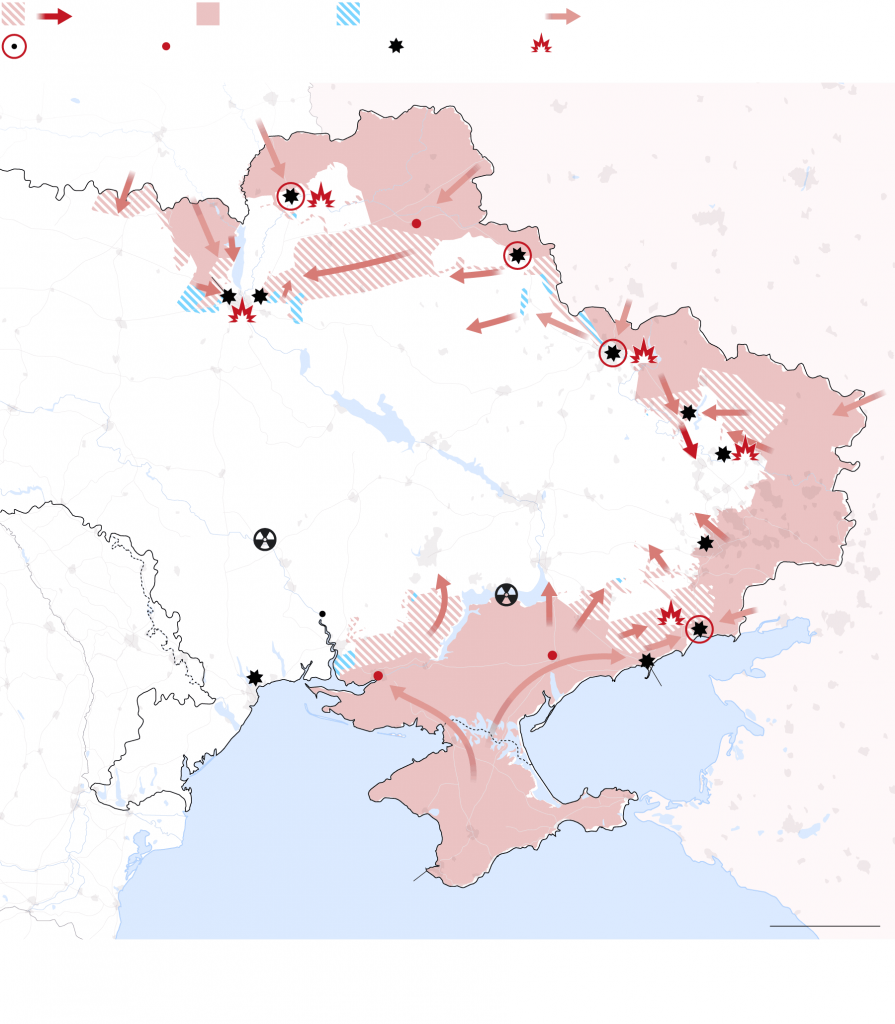
Third, it would seem that the Russian General Staff was unable to decide what the most important objective (Schwerpunkt) of their offensive was going to be. As a result they tried to advance in no fewer than four different directions at once—from the north on Kiev, from the east on the Donbas, and from the Crimea both east and west. Later they even added another thrust, i.e the one on Kharkov. Had the Russians enjoyed a considerable numerical superiority, such a strategy might have been feasible; as I just said, however, of such a superiority there could be no question. As a result, out of the five offensives three, i.e the one against Kiev, the one against Kharkov, and the one reaching west towards Odessa had to be abandoned. Only the one against the Donbas really made progress—but only very slowly, and only at high cost.

Fourth, the Russians chose the wrong season for launching their offensive: first snow, making movement difficult, then thaw, then mud. There is no question that, militarily speaking, it would have been better to wait another few weeks; why Putin did not do so is unknown.

Fifth, given the scale of preparations and the time it took to make them there was no question of the Russians enjoying the benefit of surprise. Conversely, the Ukrainians had all the time in the world to get ready.

Sixth, as the enormous traffic jam on the roads leading south from Russia to Kiev showed, logistic planning was totally inadequate. The outcome seems to have been on- and off shortages of fuel and ammunition (which, in any modern war, form the bulk of the troops’ requirements) and even food.

Seventh, contrary to expectations the Russians did not make extensive use of their superior air force. First, the attempt to end the war by means of a coup de main directed against a major Ukrainian airport on the outskirts of Kiev ended in failure. Subsequent air operations, all kinds of missiles included, appear to be scattered and ineffective. True, Ukraine’s armament industry has been destroyed. But Russian airpower does not seem to have availed them much against mobile Ukrainian forces in the field.

Finally, a “cyberwar Pearl Harbor,” as it has sometimes been called, did not materialize. To be sure, there has been a great many attacks some of which knocked out websites, disrupted communications, and the like. However, large scale anarchy, let alone paralysis, did not result. Whether that is because of insufficient preparation or because the other side was ready is not clear.

What the Ukrainians have been doing right

First, though both sides have relied on semi-regular militias (including, in the Russian case, mercenaries) to do part of their fighting, this form of military organization has played a greater part on the Ukrainian side than on the Russian one. Not only does this fact help explain the way the latter’s numerical superiority has been largely obviated, but it provided the Ukrainians with a certain kind of flexibility. Enjoying a large degree of autonomy as they do, the militias could not be neutralized simply by striking at central Ukrainian headquarters.

Second, whereas the invaders must generate their own intelligence, the Ukrainians can receive theirs from almost every man, woman and child in the country. The fact that, though the weapons used on both sides are often almost identical, the Russians have chosen to mark theirs with large letters Z helps.

Third, the Ukrainians have been making unexpectedly good use of modern weapons, especially the drones needed for in-depth reconnaissance behind the front. And including also anti-tank and anti-aircraft missiles generously provided by the West.

Fourth, on the whole they have not tried to stop the Russians by waging large sale warfare, army against army, in the open. Instead they defended the cities where winning requires the kind of numerical superiority the Russians do not have.

Finally, while the destruction inflicted on many of Ukraine’s cities has been terrible, wherever possible the Ukrainian military did not fight to the last man and the last bullet. Instead, it regularly left room for their forces’ more or less orderly retreat. Mariupol, where they allowed themselves to be put under siege, is the exception, not the rule. One which, in the future, they would be wise to repeat.

In summary

In summary the Russians, by underestimating the opponent and giving up on surprise, have committed the worst of all military sins. By contrast, the Ukrainians have exploited the Russian mistakes right up to the hilt.

However, two points are worth making. First, the available information is slanted, unreliable and, above all, extremely fragmentary. Nowhere is that more the case than in the number of dead and injured on both sides; as the saying goes, in any war the first casualty is always the truth. Second, this war is by no means over yet. The signs are that the iron dice will keep rolling for a long time, and how they will ultimately land is anyone’s guess.

What Putin Wants

First, a disclaimer. President Putin has neither been whispering in my ear nor appearing in my dreams. Nor did his advisers, senior or junior, civilian or military, official or unofficial. Nor, on the other hand, do I necessarily trust any of the usual sources mentioned by Western media. Meaning, their own countries’ intelligence services, the reports of their journalists and cameramen on the ground, tales told by Ukrainian soldiers, tales told by local Ukrainians, tales allegedly originating in Russian POWs, and so on. All these different sources, and many others besides, have their limits. Many also have an ax to grind: either to deny Russian atrocities or to emphasize them as much as possible. It is as people say. In war, any war without exception, the first casualty is the truth.
That said, and taking into account not merely Putin’s utterances but some knowledge of Russian history—as gained, among other things, by researching and writing my just-published book, I, Stalin—it seems to me that, in invading Ukraine, Putin and his advisers may be credited with a number of objectives. Here they are listed in what I think is an order of ascending importance.

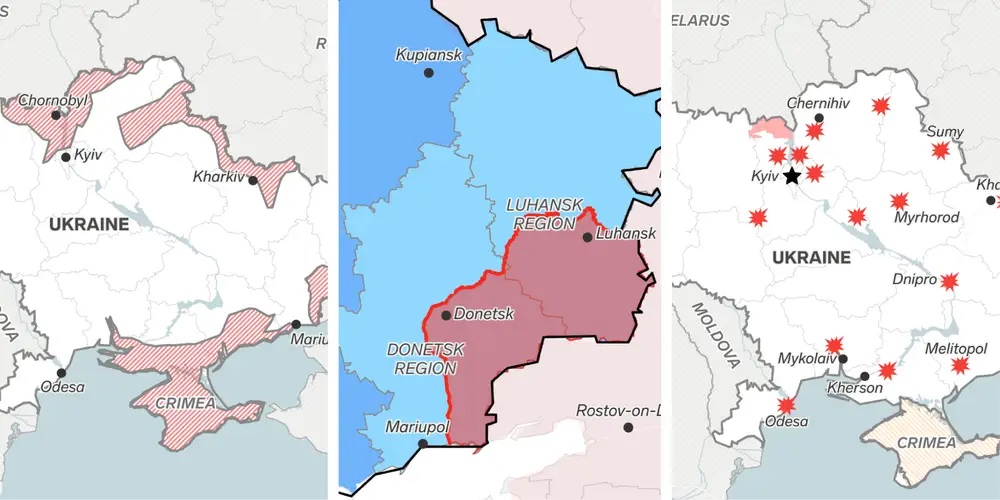
First, wresting the Donbas away from Ukraine and establishing full control over it. As Lenin himself pointed out during his last years, the Donbas by virtue of its vast reserves of coal and iron ore has long had the potential to turn into a first-class industrial zone. To put those reserves to use, all that was needed was organization—Bolshevik organization. Under Stalin, and starting with the adoption in 1928 of the First Five Year Plan, the wheels began to turn. Except during World War II, when the Germans occupied the region and razed it almost to the last brick and last metal pipe, they have kept turning right down to the beginning of the present conflict. Of all Putin’s objectives, this is the most likely to be achieved.

Second, establishing a land-bridge between Russia and the Black Sea. Long ago, it was Prussia’s Frederick the Great who said that a province to which one had access by land was worth ten times as much as one to which no terrestrial link existed. Russia’s difficulties in reaching a year-round, ice-free port are a matter of historical record. Occupying the corridor between Mariupol and the Crimea will go a considerable way towards solving the problem. It will also greatly complicate any future Ukrainian attempt to regain the Crimea, which back in 2014 the Russians annexed. I consider it just possible that Putin will achieve this objective.

Third, on the way to achieving these objectives, making sure that any future Ukrainian regime will always serve Russian interests first and foremost. Presumably this would mean a. Some kind of collaborationist government in Kiev; and b. Setting up military bases within the country so as to better control it if necessary. Briefly, something similar to the system the Soviets used between 1945 and 1989 in order to govern their East European vassals. As things look at present, this objective almost certainly will not be achieved.

Fourth, never forget that Russia without Ukraine is a country; Russia with Ukraine is an empire. As Putin has said many times, his objective is to reverse the “catastrophe” of 1989-1991 when the Soviet Union, lost its security zone to the west as well as vast other territories. Nor is this a trivial matter. During the Cold War the distance from the River Elbe, which marked the border between East and West, and Moscow was around 2,000 kilometers. With the former East Germany, the Baltic Countries, Poland, Slovakia, Hungary, Romania and Moldavia all having escaped Moscow’s control, that distance was cut by half; should the Ukraine too become part of NATO, it will be down to about 850. Now a security zone 850 kilometers wide may seem plenty to most non-Russians. Certainly it does so to an Israeli who grew up in a country only 16 kilometers wide at its narrowest point. But perhaps the Russians, who twice during the twentieth century saw their country invaded and who suffered tens millions of dead as a result, may be forgiven for thinking differently. Certainly Putin is not the only one to think in such terms. Surfing the Net, just recently I came across an alleged American plan to occupy Mars as a necessary step towards protecting the U.S against a combined Russo-Chinese attack launched from the moon. Or was it the other way around? Anyhow. This objective, too, almost certainly will not be achieved.

Fifth, securing for Russia the kind of respect to which, by virtue of its size and power and development and cultural achievements, it feels it is entitled. The West’s chronic underestimation of, and contempt for, Russia, which it perceives as a backward country lacking both good government and many of the amenities of civilized life is also a matter of historical record. Starting some three hundred years ago, the Russian intelligentsia—roughly translatable as that part of the population which has some education and is interested in ideas beyond those directly tied to people’s own daily worries—have been aware of it and resented it. This objective, too, will not be achieved; if anything, to the contrary.

Sixth, as a direct result of all these, securing for Putin personally what he sees as his rightful position as the heir of Alexander Nevsky, Ivan the Dread (not the Terrible, I am told), Peter the Great, Catherine the Great, and Stalin. Nevsky, for beating back the Estonians, Swedes, Danes, and the Teutonic Order. Ivan, for defeating the Livonians and the Tatars as well as effectively founding the Russian State with its center in “The Third Rome,” as Moscow is sometimes called. Peter, for beating back the Swedes and the Persians as well as his heroic efforts to pull up a recalcitrant Russia and modernize it. Catherine, for annexing the Ukraine (it was under her rule that Russian power first reached the Black Sea) as well as the lion’s share of Poland. Stalin, because it was under his regime that Russia/the Soviet Union reached the peak of its power, making the rest of the world tremble in front of it. Of all Putin’s objectives, this one is the least likely to be achieved.

A final point. Seen through Western eyes, these and all other Russian rulers were autocrats of the worst kind whose most important instruments of (miss) rule were the knout, the labor camp, and the hangman’s noose. But that is not how Putin himself sees things. According to him, Russians do not need either liberalism or democracy. The reason being that, unlike Westerners, they trust their leaders.

So, he claims, it has been in the past. And so, no doubt, he hopes it will be in the future.

Guest Article - The Ghost of 1914

By

Bill Lind*

World War I ended with a global pandemic. Has the next world war begun with one? I pray not, but no historian can look upon the war in Ukraine and not see the ghost of 1914 rising wraithlike from it – a ghost which, I fear, bears a striking resemblance to Conrad. When was Przemsyl last in the news?

When we think back to World War I, to its origins, its course and its consequences, the parallels are frightening. The first is that, in 1914, no one expected war or wanted war – at least a general European war. Kaiser Wilhelm II certainly did not. On the contrary: as soon as he realized, too late, where events were leading, he made desperate efforts to head them off. He ordered a cable sent to Vienna telling Austria to take Belgrade and then stop, but the German Foreign Office did not send it. Tsar Nicholas only approved the order for mobilization with great reluctance; his war and Foreign Ministers acted before he could change his mind. The Kaiser even halted his army on the Belgian frontier when the British Foreign Secretary hinted Britain might stay out – but then Grey pushed the British cabinet in.

Are events today again running away from those who seek de-escalation? Russia expected a quick victory (like everyone in 1914), but now finds herself bogged down in a stalemate with no clear exit. As wars go on, they tend to spread. The West is upping the ante in the help it is extending to Ukraine. At what point does Russia start hitting Western weapons shipments while they are still on NATO’s soil? How long can China remain on the fence when Russia is her principal ally? If Russia uses chemical weapons in urban combat, does the U.S. wrongly declare them “Weapons of Mass Destruction” and thereby open the nuclear Pandora’s box? There are a lot of ways for this conflict to get bigger, fast.

The parallels do not end with the merely military. In 1914, the world had a global economy. Only in the last decade did the value of global trade reach 1914 levels, as a percentage of the global economy. But even before Russia invaded Ukraine, America’s use of economic sanctions as weapons was swiftly undermining Globalism, as did the Coronapanic and its effects on global supply chains. Now, every country is striving to “re-shore” whatever it can, in a security-driven race towards autarky.

World War I ended with the destruction of three great, Christian, conservative empires, the Russian, the German, and the Austro-Hungarian, with ongoing consequences for Christendom. What states may fail as a result of the war in Ukraine and its potential expansion? Then, the old empires reformed as republics. But now, we live in a time when the state is in decline and non-state entities are rising. Fourth Generation War theory says that a defeated Russia might break up still further, as the Soviet Union did, to become a vast stateless region with lots of nukes and delivery systems floating around.

What then, Russophobes, which is to say the Blob, the neocons, and the neo-libs? You destroyed states such as Iraq, Syria, and Libya and have not been able to put them back together. What is your plan for a stateless region running from the Polish border to the Pacific Ocean?

The political establishments in Washington and the EU would be wise to remember that World War I brought a wholesale collapse of establishments. The monarchies in Russia, Austria, and Germany were swept away, replaced in the first by Bolshevism and the latter two by socialism. Shortly after the war, in 1922, the Italian political establishment was replaced by Fascism, and in 1933 in Germany by National Socialism. Do the cultural Marxist elites that now rule in Washington and most European capitals think they are likely to survive a cataclysm they created? (I promise them their replacements will come from the right, not the left.)

If those establishments want to survive, they need now to bend every effort to de-escalate the war in Ukraine, to build a golden bridge Russia can withdraw over without humiliation, one where the Kremlin can claim some sort of victory (i.e., Ukraine will never join NATO and Crimea is recognized as Russian) and all Western sanctions are quickly removed. The U.S., the E.U., and Russia then join to rebuild Ukraine.

In 1914, the post-1815 European order sleepwalked itself into a world war that swept it from the board. In 2022, the post-1945 world order is on the verge of doing the same.


* William S. Lind is a long-time American defense analyst and social critic. This article has been previously published in Traditional.Right.

The Guessing Game

There are two cardinal reasons why President Putin has almost certainly lost the war he launched over a month ago. Both are as old as history, and both were set forth by Clausewitz around 1830. First, a military operation, large or small, is much like pouring water from a bucket (the metaphor is mine, not Clausewitz’s); the further away from its point of origin it flows, the more momentum it loses and the more vulnerable it becomes to counterattacks directed both against the spearheads and against the attacker’s lines of communication. Just think of Napoleon in 1812. Having invaded Russia with 600,000 men, by the time he reached Moscow he only had 100,000 left; all the rest had either perished by battle, disease and fatigue or been left in the rear to garrison key positions there. 100,000 troops were not nearly enough to force a decision, let alone hold the country down. And so all it remained for him was to retreat.

The second and even more fundamental reason is that time works against the attacker. Why? Because, under most circumstances, conquering and appropriating is harder, and requires greater force, than holding and preserving. An offense that does not attain its objective—from the attacker’s point of view, that would mean a better peace—within a reasonable amount of time is certain to turn into a defense. Think of Hannibal in 218-17 BCE, think of Hitler in 1941-42. Again this applies to any military operation, large or small, old or new.

So far, Putin’s war has proceeded in four stages. First, a combination of geography and numerical superiority enabled his forces to operate on external lines and invade Ukraine from four different directions (northwest, north, east and south) at once. Second, enjoying both numerical and technological superiority, and some logistic problems notwithstanding, those troops pushed the Ukrainians aside and reached the outskirts of the most important Ukrainian cities such as Kharkov, Kiev, Kherson, and Mariupol (important because of its command of the Sea of Azov as well as the road from the Donbas to the Crimea) and put them under siege. Third, especially at Kherson and Mariupol, they tried their hand at urban warfare. Only to find, as countless others before them have also done, that such warfare tends to be very bloody and very destructive. The difficulty of obtaining intelligence, the excellent shelter cities provide to those who defend them, and the way rubbish-filled streets canalize and hamper the attacker’s movements all contribute to this result; between them they cause cites to swallow up armies the way sponges take up water.

Fourth, and rather predictably, the Russians switched from attempts to capture Ukrainian cities to subjecting them to artillery bombardment. Just as, some twenty years ago, they did in Grozny. In Kherson and Mariupol the tactic worked, at any rate up to a point. However, Kiev and Kharkov are much larger than either of those. Besides, Ukraine itself is a large country with many urban areas, large and small. Not even the Russian army, famed for its reliance on artillery, has enough guns to take them on all at once; whereas doing so one by one will require enormous amounts of time which, for the abovementioned reasons, Putin simply does not have.

Fifth, the offensive having exhausted itself, stalemate will set in if, indeed, it had not done so already. Stalemate having set in politics, which right from the beginning played a very important role, will start playing an even more important one. All sides will have a strong interest in ending the war. Hence attempts will be made to do so on terms all of them —Russia, Ukraine, NATO—will find more or less acceptable or at least capable of being presented as such.

Just what the final settlement will look like is impossible to say; most probably, though, it will include the following elements. First, there can be no question of doing away with Ukraine as an independent country and nation. Second, there will be no subservient government in Kiev as there is in Minsk. Third, Russia will make no important territorial gains beyond those made in 2014 and even its ability to hold on to those is in some doubt. Fourth, Ukraine will not officially join NATO, let alone have NATO forces stationed on its territory; but other, more limited, forms of cooperation between the two entities will certainly be established and maintained. Fifth, Putin may, but not necessarily will, lose his post.

Finally, never forget that war, though it makes use of all kinds of physical assets such as numbers of troops, weapons, equipment, roads, communications, topographical and geographical obstacles, and so on, is a human drama above all. As such it is critically affected by every kind of human, often incalculable, drives and emotions; which, collectively, shape the fighting power of both sides. Taking all this into account, it becomes only too clear that anything that can be said about the way future campaigns will develop is no more than what Clausewitz calls a calculus of probabilities.

So it has been, and so it will remain

Chaos

As far as anyone can make out, the situation in Ukraine is nothing if not chaotic. Russian forces are said to be advancing on all fronts. Ukrainian forces claim success after success in slowing down the aggressors or even halting them. Now cities are said to have been cut off, now it appears that, in reality, they are not. Cities are occupied, or else they are not and the two sides keep fighting over them. Convoys seem to be get stuck for days on end, but no one knows why. The Russians are running out of supplies. The Russians so far have only committed about three quarters of their forces. The Russian air force is said to be either held back or ineffective, yet President Zelensky keeps begging the West to impose a no fly zone.

Both sides accuse the other of committing war crimes and provide casualty figures; but neither is at all complete or reliable and there is good reason to believe that many are neither. A maternity hospital is said to have been hit, but whether it was done deliberately or as part of what is euphemistically known as “collateral damage” is obscure. The Western sanctions on Russia are working, or else they are little more than a nuisance that can be taken care of with Chinese help. The Russians are running out of young soldiers (hard to believe, since Russia’s birthrate, while below the replacement figure, is actually higher than that of Ukraine). Putin is winning on all fronts. Putin knows he has bitten off more than he can swallow and is desperately looking for a way out. Putin is ill. Putin is mad. Putin is about to be deposed, though no one knows by whom.

Millions of messages are being sent, intercepted, recorded, decrypted, stored, and analyzed by every possible means from artificial intelligence down. Some are even being falsified. To make things worse still, joining the Niagara of words is a tsunami of images. Attempting to prove their claims, both sides are publishing countless photographs, clips, videos, or whatever they are called. And that does not even include the millions of images sent out by the media on their own initiative. However, most of the time it is impossible to say who took them, when, where, in what context, and for what purpose. To say nothing of the fact that, since the uniforms worn by both sides and much of the materiel they use are broadly similar, it is often impossible to say what is what. One gets to see a shot up vehicle; but who destroyed it impossible to say. One sees wrecked building; but who wrecked it and why is impossible to say. A corpse is shown lying on the pavement; but whose corpse it is, and who killed him, is anything but clear. Briefly, it is not true, as Hitler’s propaganda minister Joseph Goebbels used to say, that bilder luegen nicht. Indeed that itself is perhaps the greatest lie of all.

Except for the sheer amount of information being passed around, there is nothing new or exceptional about all this. Sun Tzu, the ancient Chinese soldier-scholar who probably wrote his Art of War around 500 BCE, says that all warfare is based on deceit and that, of all the ways to defeat an enemy, tricking him is the swiftest and the best (also in the sense of being the least bloody). Carl von Clausewitz, the Prussian general and military theorist who wrote vom Kriege during the 1830s, says that, in war, almost all information (Nachrichten) is contradictory, false, or both. Napoleon, who though neither a theoretician nor a writer was one of the greatest commanders who ever lived, adds that making sense of the confusion is a task not unworthy of geniuses such as Isaac Newton and Leonhard Euler. He himself, incidentally, was a master of deceit—a talent he displayed not just on campaign, as by “stealing a march” on his enemies, but while playing cards as well.

For all the vast technological apparatus it uses, modern war has not been exempt from these problems. To the contrary, in some ways it has made them worse than ever. One factor responsible for this is the sheer amount of information in the hands of, or being generated by, decision makers, soldiers, intelligence services, the media, and individuals on all sides. Let me provide just one example of what this may mean. Back in 1991 headquarters US Marine Corps, preparing to invade Kuwait, received a million and a half satellite-images of the terrain in front of it. This, on top of other kinds of information too numerous to detail here. So enormous was the flood that the images were almost entirely useless—the manpower, the expertise and the time needed to make them useful where simply not available. Since more was being added every hour, processing all of them would have lasted literally forever. The development of artificial intelligence may have alleviated some of these problems. But certainly not all.

A second problem originates in the illusion that we are in full command of our faculties, meaning that our senses provide us with a realistic idea of the world around us. In fact, however, this is by no means always the case. Our minds are colored by fear, elation, hope, despair, disappointment, and a thousand other emotions. Coming on top of this, often what we see depends, not on incoming information but on what we are; as shaped by education, training, prejudice, and so on. No two people, no two organizations, are the same or see the world in the same way. Which means that, even if all the relevant information is available, the task of entering into the enemy’s mind and guessing his intentions is very difficult, not seldom impossible.

Third, in war all these problems are exacerbated by what Clausewitz calls its Strapazen. War is the most strenuous activity any human can engage in by far. To those who have not gone through it the mental and physical stress are simply unimaginable. Partly because of the ever present danger to limb and life, one’s own and those of others; and partly, at the upper levels, because the fate of countries and populations may very well depend on it. Such is the strain that it often causes even the very bravest and most stable to behave somewhat strangely. If not all the time, then certainly some of it. Under such conditions no wonder (as Napoleon said) that false reports proliferate. Some people see entire armies where, in fact, there are none; others don’t see armies even when those armies are right in front of their noses.

A final point that, as far as I am aware, analysts have raised rarely if at all. It goes without saying that, ceteris paribus, the chaos of war affects both the conqueror and the conquered. However, as a rule creating order out of chaos—the conqueror’s task—is a lot harder than doing the opposite; think, for example, of building a new wall brick by brick as opposed to taking up a sledge hammer and bringing it down. Without imposing order on a recalcitrant country, the Russians cannot win. As a result, this factor will probably work in favor of the defender. The Israelis in Lebanon, the Soviets in Afghanistan and the Americans in both Afghanistan and Iraq all tried their hand at this game. Ultimately, to no avail.

Ukraine is a large country with long, hard to seal, borders as well as tens of millions of able and highly motivated inhabitants. Chances are that the same will happen in this case.

When the Guns Fire

Two weeks into the war—no need to explain which war I am referring to here—the situation appears to be as follows.


General

Contrary to the view of some of us, who considering the military balance predicted a fast and fairly easy Russian Blitzkrieg, this is turning out to be a prolonged and quite bloody war. Unless some miracle happens, it will get worse before it gets better.

Military Operations

Russian military operations are being conducted in full force and with few if any restraints.


Coming from several directions at once, they have succeeded in occupying one important city (Kherson) and are currently besieging and shelling several others. As one would expect from the side that is short of almost everything, Ukrainian resistance, though deserving of all respect, appears to be sporadic and ill-coordinated with each city and each force acting more or less on their own. Though Russian airpower does not play as much of a role as most people thought it would, it does dominate the sky. Still the Russians have not yet got even close to breaking the Ukrainian will to resist and fight. Perhaps, to the contrary.

Spread and Escalation

Contrary to many predictions, too, so far the war has remained inside Ukraine and did not spread to neighboring countries such as Moldavia and Poland.

Nevertheless, spread (“horizontal escalation, as it is sometimes called) and escalation remains very real possibilities. Suffice a single mistake, most likely in connection with NATO aircraft overlying Ukrainian territory (either deliberately or by accident) or with a Russian attacks on NATO attempts to assist Ukraine, to set Europe aflame and perhaps bring it to a glowing end. No wonder NATO is resisting President Zelensky’s calls for the establishment of a


non-flight ban over his country. But it is not going to happen.

The Situation in Russia

The sanctions are really hurting Russia’s population. Not so much because people are starving, as they were during under Stalin in 1930-31 as well as during and immediately after World War II. But because of their sense of being cut off from the world. Including news emanating from any sources except their own government, not known as the most truthful in the world. The oligarchs have also taken heavy losses.

On the other hand, there is no sign of serious opposition to Putin. Claims about him being angry with his generals—at any rate, angry enough for it to make a difference—also seem to be without sufficient foundation in fact.

Economic Impact

The sanctions on Russia apart, the impact of the war on the global economy has been very serious. Production is down, inflation is up. That is especially true for such products as energy (oil and gas) and wheat. Gold is king. As always, though, there are those who prof


it. Including, above all, owners and producers of the commodities in question. And including arms manufacturers in many places around the world.

On one hand, the international rating agencies keep announcing Russia’s imminent bankruptcy. On the other, Russia is among the greatest profiteers. Not only is it among the largest producers of both energy and wheat, but it sells them dear to whomever will buy. Primarily, it seems, China. Now even Germany has announced it cannot do without Russian gas. Which of these two trends prevails we shall see soon enough.

As I am writing these lines on 9 March the Euro is slightly up against the dollar whereas gold and gas are slightly down. Are people getting used to the new reality? Again, we shall see soon enough.

International Impact

The Russian attack on Ukraine has brought almost all of Europe’s remaining countries closer together. Countries that always refused to join NATO and/or the EU (which is also an alliance against attack, albeit that it is seldom mentioned) are now actively considering doing just that. Good; but one doubts whether it can last.

Some false prophets notwithstanding, so far the war has not led China to mount an attack on Taiwan. Instead, the Chinese leadership seems to be weighting its options. There is a good chance that, if the war continues as it almost certainly will, China will emerge as the great tertius gaudens. Without firing a shot, what is more.


Attempts to End the War

So far, none of any importance. But clearly any solution, even if it does not fully meet Putin’s initial demands, can only come at the expense of Ukraine. Given how fearful NATO is, such a solution is not impossible. But it will take time.


Varia

Following decades of neglect, events are forcing Europe’s politicians as well as its populations to take war and the military seriously. There is even occasional talk of a return to conscription. However, it probably won’t happen. Even if it does, putting the necessary arrangements in place, procuring the necessary weapons and equipment, and organizing the necessary training will take years.

Following decades of feminist b.s, it turns out that few if any women participate in combat either on the Ukrainian side or, much less so, the Russian one. Ukrainian men are expected to fight and are barred from leaving the country, which some consider a violation of their human rights; Ukrainian women are not. Had events not been as tragic as they are, one could almost have said, “alles in ordnung” (everything is OK).

To Sum Up

The first casualty is the truth. Which incidentally means that there is no way to verify the casualty figures published by both sides.

Ukraine, Russia, Europe and the world are in an even greater mess than usual.

When the guns fire, the children cry.